For journalists.
Product descriptions, founder bio, brand assets, and a direct contact. Use what's useful; skip what isn't.
Product descriptions
50 words
Noorani is a desktop browser built around how Muslims live online. Prayer times, Qibla, Hijri calendar, Quran quick-access, and thoughtful filtering are woven into the browser itself — not bolted on as widgets. Free, open source, privacy-first. Available for Windows, macOS, and Linux. Built by Ataraxy Developers, Islamabad.
150 words
Noorani is a free, open-source desktop browser designed specifically for how Muslim users engage with the web. It computes prayer times locally on your device using six calculation methods. It displays the Hijri date alongside the Gregorian. It shows Qibla bearing from any location. It blocks ad trackers by default, offers optional content filtering at three sensitivity levels, and allows instant Quran verse lookup from the address bar. Built on Chromium — the same engine as Chrome, Edge, and Brave — Noorani ships with no telemetry, no analytics infrastructure, and no ad-supported business model. The product is a product, not an attention broker. Noorani is developed by Ataraxy Developers, a software agency based in Islamabad, Pakistan, and launches in Q2 2026 for Windows, macOS, and Linux.
300 words
Noorani is a free, open-source desktop browser built for the approximately two billion Muslims who currently navigate the web using tools that weren't designed with their daily rhythm in mind. It answers a simple question: what would a browser look like if the defaults assumed a user who prays five times a day, follows the Hijri calendar, and values privacy as an amānah rather than a marketing slogan?
The answer is a Chromium-based browser with prayer times computed locally using six established calculation methods (Karachi, ISNA, MWL, Umm al-Qura, Egyptian, Tehran), a precise Qibla indicator in the toolbar, the Hijri date always visible, instant Quran verse lookup, optional content filtering at three sensitivity levels, and aggressive tracker blocking on by default. A Ramadan mode (shipping in v1.1) reconfigures the browser's posture for the month.
What's absent is as important as what's present: no telemetry, no analytics server, no advertising, no data brokering, no engagement metrics the product is optimised against. The business model is deliberately different from the attention economy that shapes most browsers.
Noorani is built by Ataraxy Developers, a software agency based in Islamabad, Pakistan, founded by Waleed Naeem. Ataraxy has delivered software for clients across the US, UK, Europe, and the Gulf since 2022; Noorani is its first original product. Launch is planned for Q2 2026; versions 1.1 and 1.2 follow in Q3 and Q4. The browser is free, source code is public, and installation requires no account.
Founder bio
Waleed Naeem is the founder of Ataraxy Developers and the creator of Noorani Browser. Based in Islamabad, he has led software delivery for clients in healthcare, education, insurance, and hospitality since 2022. His interest in building a browser for Muslim users grew from a simple observation: every existing browser is a retrofit, decorated with extensions and workarounds, and none of them was designed for the way he and many around him actually use the internet. Noorani is his answer.
Logo downloads
The Noorani mark is an eight-point rub el hizb star, rendered as two overlapping squares. Three variants are available for editorial and press use:
- Logo (full colour) — primary use, gold on light
- Logo (monochrome) — single-colour, light or dark backgrounds
- Wordmark — Fraunces "Noorani" text


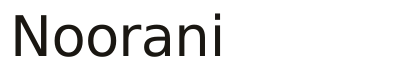
For full usage rules, colour palette, and typography, see our brand guidelines.
Screenshots
A press-grade screenshot pack will be available here alongside the v1.0 release. In the meantime, the homepage preview is representative of the new-tab interface.
Press contact
pr@nooranibrowser.com with [PRESS] in the subject. We aim to reply within 24 hours for press inquiries.
Coverage
Coverage will appear here as Noorani launches.